 Loading... Please wait...
How to Vet a Liquid Filling Machine Manufacturer
Posted on 30th Jul 2026
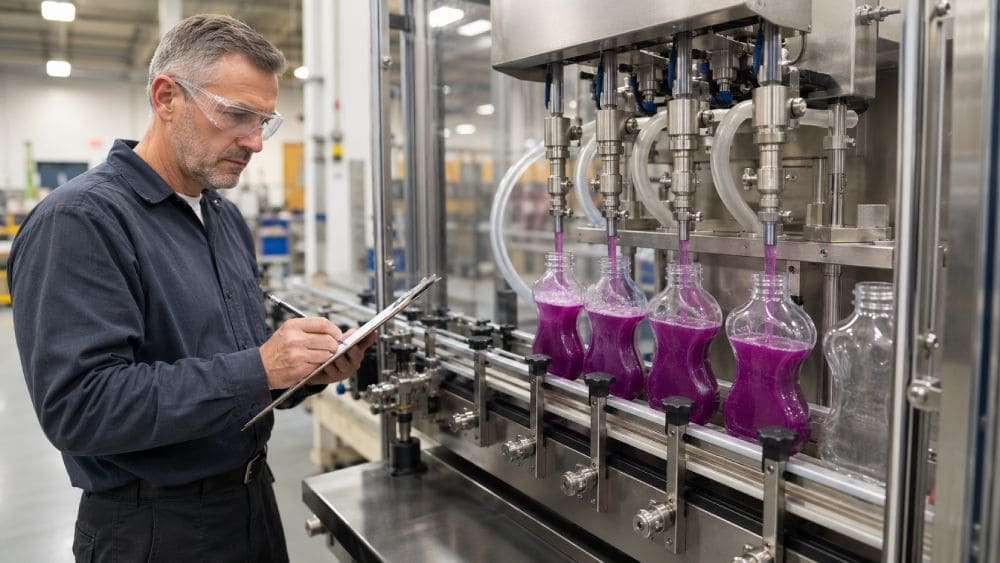
Buying a liquid filling machine is a major production decision. The right equipment can improve output, accuracy, consistency, and uptime. The wrong fit can lead to waste, slow changeovers, maintenance issues, and problems across the rest of your packaging line. That’s why it’s important to vet the manufacturer, not just the machine.
A qualified supplier should understand your product, container, facility, production goals, and long-term capacity needs before recommending a solution.
In this article, we’ll cover where to look for liquid filling machine manufacturers, what factors to consider, and what steps to take before choosing a supplier.
Where to Look for Liquid Filling Machine Manufacturers
Finding potential suppliers is not difficult. Finding the right suppliers is where the work begins.
Your goal should be to identify manufacturers with relevant experience, suitable equipment, strong support, and the ability to understand your application before recommending a machine.
Packaging Equipment Directories & Trade Associations
Packaging equipment directories can help you identify manufacturers by equipment type, industry, location, or application. These resources are especially useful when you are in the early research stage and want to understand who serves your market.
However, treat directories as a starting point, not the final filter. A listing can tell you that a company sells liquid filling equipment, but it won’t tell you whether they are the right fit for your product.
Once you find potential manufacturers, move to their websites and begin a deeper review. Look for machine categories, service capabilities, application experience, replacement parts, customer support options, and signs that they understand complete packaging line performance.
Trade Shows & Industry Events
Trade shows can be helpful because they let you see equipment in person, compare manufacturers side by side, and ask technical questions directly.
When visiting a booth, pay close attention to how the manufacturer responds to your application. A good supplier should ask about your product, fill volume, container type, production speed, viscosity, temperature, sanitation needs, facility layout, and existing equipment.
Be careful with buying decisions based only on what looks impressive on the trade show floor. Demonstration machines are often set up under controlled conditions. Your product, containers, operators, cleaning routines, and production schedule may introduce very different demands.
Use trade shows to narrow your options, gather information, and evaluate how suppliers communicate. Then continue the vetting process with application details, samples, technical conversations, and quote comparisons.
Referrals From Industry Peers
Referrals can be useful, especially when they come from companies with similar products or production environments.
Ask peers what equipment they use, why they chose that manufacturer, and how the machine has performed after installation. The post-sale experience is often more revealing than the initial buying process.
Useful questions include:
- Did the manufacturer understand the product and packaging requirements?
- Was the equipment delivered as expected?
- How difficult was installation and startup?
- Were operators trained properly?
- How responsive has technical support been?
- Are spare parts easy to order?
- Has the machine been reliable during regular production?
A referral from a company with a similar product is stronger than a general recommendation. For example, a manufacturer that performs well for bottled water may not automatically be the best fit for a thick sauce, corrosive cleaner, hot-filled product, or molten liquid.
Existing Vendors & Line Integration Partners
Your current vendors may also be useful sources. Container suppliers, cap suppliers, label suppliers, capping equipment companies, packaging consultants, and automation partners may know which filling machine manufacturers are easier to work with.
If you’re adding a filler to an existing line, ask vendors about compatibility. If you’re building a new line, look for a manufacturer that can discuss the full packaging process rather than treating the filler as an isolated machine.
Factors to Consider When Vetting a Liquid Filling Machine Manufacturer
Once you have a shortlist, the real vetting process begins. Price is an important consideration, but it shouldn’t be the first or only filter. A lower-cost machine can become expensive if it creates downtime, inconsistent fills, product waste, labor issues, maintenance problems, or integration delays.
Use the following factors to evaluate whether a manufacturer can support your application properly.
Product & Application Expertise
Your product should drive the equipment recommendation.
A thin, free-flowing liquid behaves very differently from a viscous sauce, foamy cleaner, abrasive chemical, hot-filled product, product with particulates, corrosive liquid, or molten material. Each product type can affect machine design, nozzle selection, pump selection, product contact materials, filling method, cleaning procedure, and production speed.
A qualified manufacturer should ask detailed questions before recommending equipment. They may ask about:
- Viscosity
- Product temperature
- Foaming behavior
- Particulates or chunks
- Fill volume range
- Container size and shape
- Container opening
- Closure type
- Required speed
- Cleaning requirements
- Washdown needs
- Chemical compatibility
- Safety or regulatory requirements
- Future product variations
If a manufacturer recommends a machine before learning these details, slow down. That’s not a good sign. The machine may be easy for them to sell, but that doesn’t mean it’s right for your operation.
Range of Equipment Options
A manufacturer with a broader equipment lineup can usually recommend based on fit rather than forcing every buyer into one machine type. Look for options across different production levels, including manual, tabletop, semi-automatic, and fully automatic systems. Smaller or growing companies may not need full automation immediately. Larger operations may need equipment that supports higher speeds, multiple fill heads, faster changeovers, or integration with other automated machinery.
Also consider whether the manufacturer offers more than fillers. Liquid packaging lines often include bottle cleaning, filling, capping, labeling, coding, conveying, accumulating, and sometimes case packing or other downstream steps.
Even if your immediate need is a filler, a manufacturer that understands supporting equipment can help you avoid problems later.
Customization Capabilities
Not every application fits neatly into a standard machine package. Your operation may need adjustments based on product characteristics, container shape, fill volume, sanitation needs, corrosive materials, hazardous conditions, available floor space, operator access, or existing line equipment.
Customization may involve:
- Fill head configuration
- Nozzle design
- Pump type
- Product contact materials
- Controls
- Conveyor layout
- Container handling
- Safety guarding
- Drip control
- Change parts
- Washdown design
- Integration with existing equipment
Ask how the manufacturer handles applications that require more than an off-the-shelf machine. A strong manufacturer should be able to explain what can be modified, why it matters, and how those choices affect cost, lead time, performance, and maintenance.
Build Quality & Materials
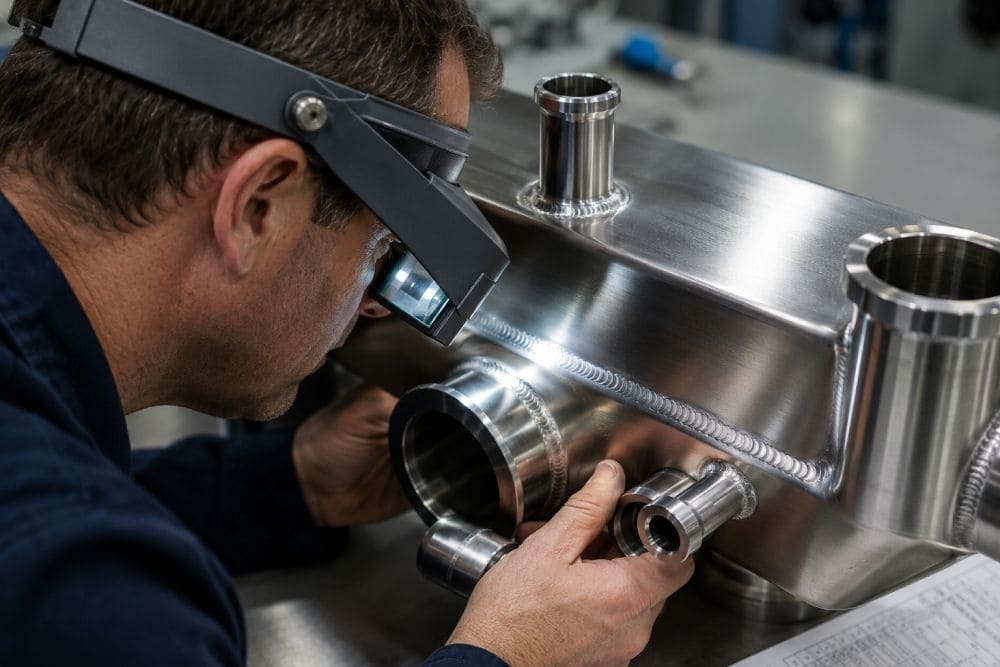
Build quality affects machine life, reliability, sanitation, cleanability, and maintenance.
Ask about the materials used in machine construction, especially in product contact areas. The right materials depend on the liquid being filled and the environment where the machine will operate. Food, beverage, pharmaceutical, chemical, corrosive, washdown, and hazardous applications may require different design considerations.
You should also ask how the machine is built for daily use. A machine may look good on paper, but production reality includes vibration, cleaning, operator adjustments, product spills, changeovers, and continuous operation.
Pay attention to accessibility. Operators and maintenance teams need to reach the areas they clean, adjust, inspect, and repair. A machine that is difficult to access can slow down production and make routine maintenance harder than it needs to be.
Accuracy, Repeatability, & Waste Reduction
Fill accuracy is a cost issue. Overfilling gives away product. Underfilling can create rejected containers, unhappy customers, or compliance concerns depending on the industry. Inconsistent filling can also affect capping, labeling, packaging appearance, and customer trust.
Ask how the machine controls accuracy and how repeatable that accuracy is across your full range of fill volumes and containers.
Several factors can affect fill performance, including viscosity changes, temperature changes, product foaming, pressure, particulates, nozzle design, container shape, operator setup, and maintenance condition. A good manufacturer should be able to explain what affects accuracy in your specific application and how the recommended system addresses those factors.
Production Speed & Scalability
Before requesting quotes, define your current and future production needs.
Be specific. Document your current containers per minute, target containers per minute, number of shifts, labor availability, stock keeping unit (SKU) count, changeover frequency, and expected growth. Then ask whether the recommended machine can support those needs. In some cases, the right answer may be a semi-automatic system that improves output without overcomplicating the line. In other cases, you may need an automatic filler with multiple fill heads, conveyors, and integrated capping or labeling equipment.
Scalability is important. A machine that barely meets today’s demand may become a bottleneck as order volume grows. On the other hand, overbuying automation too early can create unnecessary cost and complexity.
The right manufacturer should help you find the balance between current production reality and future growth.
Line Integration Experience
A filler is one station in a larger packaging process. Before you choose a manufacturer, make sure they understand how the filler will connect to the rest of the line, including bottle handling, cleaning, filling, capping, labeling, coding, conveying, accumulation, inspection, and operator workflow.
If you already have equipment, the new machine must work with what’s in place. If you’re building a new line, the manufacturer should be able to discuss floor space, utilities, container flow, operator access, cleaning access, safety, and future expansion.
Line integration mistakes can create expensive problems. A filler may technically meet the speed requirement, but if the capper, labeler, conveyor, or operator workflow cannot keep up, the full line will still underperform.
Sanitary, Corrosive, Hazardous, or Specialized Application Experience
Some liquids require specialized equipment knowledge.
Food products, beverages, pharmaceuticals, personal care products, acids, corrosive chemicals, flammable solvents, hot-filled products, molten products, paints, stains, sealants, and agricultural products can all create unique requirements. For example, sanitary applications may require cleanable designs and materials suitable for product contact, while corrosive products may require compatible components that resist chemical attack.
Ask whether the manufacturer has experience with your type of product and environment. Similar experience reduces risk because the manufacturer is more likely to understand the real challenges before the machine is built.
Technical Support & Service
The buying process doesn’t end when the machine ships. Installation, startup, training, troubleshooting, preventive maintenance, replacement parts, and field service all affect the long-term value of the equipment.
A manufacturer may be responsive during the sales process, but you also need to know what happens after the purchase. Ask how support is handled. Can you call for technical help? Do they offer remote troubleshooting? Is field service available? Who supports installation? What training is provided for operators and maintenance teams?
Production downtime can quickly become expensive. A machine is only as valuable as your team’s ability to operate it, maintain it, and get help when something goes wrong.
Parts Availability
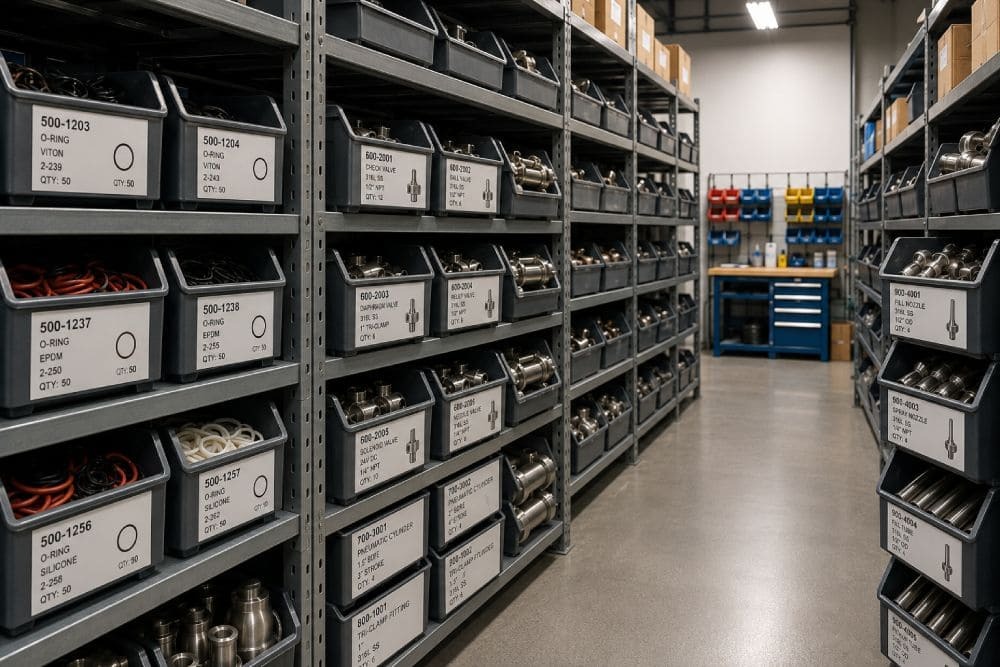
Spare parts are often overlooked during the buying process, but they become critical once the machine is in production. Ask which wear parts you should keep on hand, how quickly common parts can ship, whether the manufacturer supports older machine models, and whether they can help identify parts if your team doesn’t know exactly what to order.
A good parts strategy can reduce downtime and make maintenance more predictable. Waiting until a machine is already down to think about spare parts is a poor plan.
Training & Operator Usability
The best equipment still needs trained operators. Ask whether training is included during installation or available separately, what documentation comes with the equipment, and how operators will learn to set up, run, clean, change over, and troubleshoot the machine.
Usability also affects daily performance. If setup is overly complicated, operators may make mistakes. If changeovers take too long, production loses time. If cleaning is awkward, sanitation and maintenance routines can suffer.
A manufacturer that understands operator use can help you choose equipment that fits the people who will run it every day.
Reputation & Proof
Reputation should be evaluated carefully. Look for customer testimonials, case examples, company history, product documentation, and signs of long-term market presence. When possible, ask for references from companies with similar products, containers, speeds, or production environments.
Don’t settle for vague proof. A supplier may have sold many filling machines, but you need to know whether they have solved problems like yours.
For example, if you package a thick sauce with particulates, a reference from a company filling thin liquids may not tell you enough. If you handle corrosive chemicals, you need proof that the manufacturer understands chemical compatibility and specialized equipment needs.
Quote Quality & Transparency
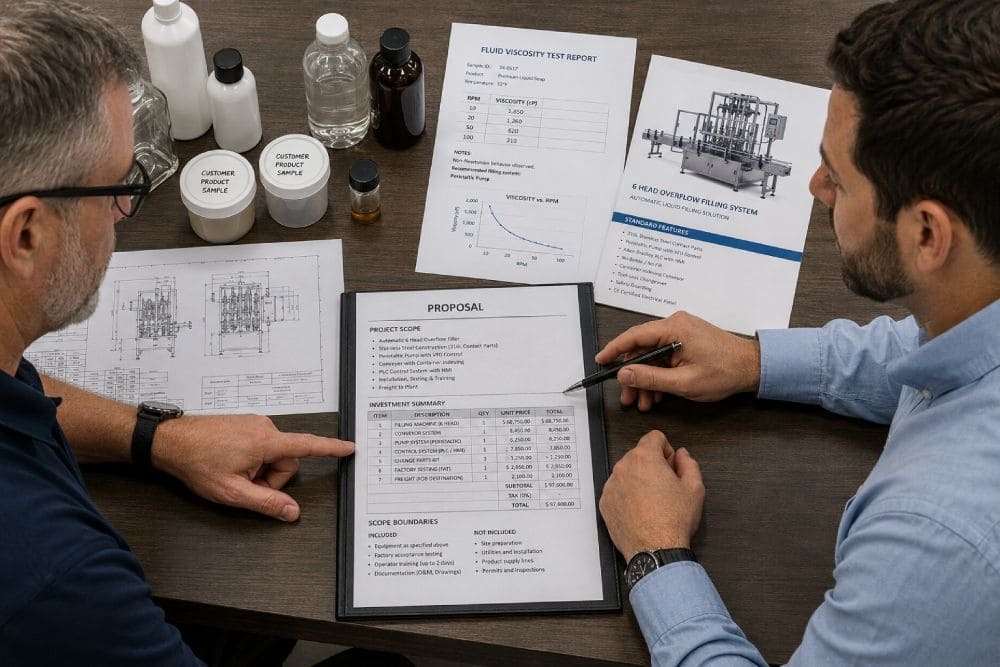
A strong quote should explain what is included, what is excluded, and what assumptions were used. It should cover the machine type, options, number of fill heads, expected speed, controls, materials, change parts, support equipment, installation, training, warranty terms, lead time, freight, payment terms, and any services included.
Compare total value, not just purchase price. The cheapest quote may exclude important components or services. It may also create higher costs later through downtime, product waste, poor support, or limited scalability.
If a quote is vague, ask for clarification before making a decision. Ambiguity before purchase often becomes frustration after purchase.
8 Steps to Take Before Choosing a Liquid Filling Machine Manufacturer
A structured process will help you make a better decision and makes quote comparisons more useful because every manufacturer is working from the same information.
Step 1: Document Your Application Requirements
Before speaking with manufacturers, collect the details that will shape the equipment recommendation.
Start with the product. Document viscosity, temperature, particulates, foaming tendency, chemical compatibility, sanitation requirements, hazardous conditions, and any special handling needs. Then document the packaging. Include container material, size, shape, opening, closure type, label requirements, fill volume range, number of SKUs, and expected changeover frequency. Finally, document production goals. Include current output, target output, number of shifts, labor availability, facility constraints, utilities, current bottlenecks, and expected growth.
This information makes conversations more productive and reduces the risk of getting an inaccurate recommendation.
Step 2: Shortlist Manufacturers with Relevant Experience
Use your research to create a focused shortlist. Prioritize manufacturers with experience in your product category, filling method, container type, and production environment. Review their equipment range, service capabilities, parts support, and ability to provide line integration help.
Remove obvious mismatches early. If a manufacturer does not offer the machine type, automation level, customization, service support, or specialized experience you need, do not force the fit.
The strongest shortlist is the list with the best match between your requirements and the manufacturer’s capabilities.
Step 3: Prepare Technical Questions Before the First Conversation
A good first conversation should reveal how well the manufacturer understands your application.
Ask how they would approach your product, what type of filling technology may be appropriate and why, what information they need before making a formal recommendation, and what challenges they see in the application. Pay attention to whether they ask thoughtful questions. A manufacturer that listens carefully and gathers details is usually safer than one that jumps immediately to a quote.
Also, pay attention to how clearly they explain tradeoffs. There may be more than one way to fill your product, but each option may affect cost, speed, accuracy, changeover, maintenance, or future scalability.
Step 4: Request an Application Review or Consultation
Once you identify serious candidates, share detailed application information. Depending on the manufacturer and the complexity of your product, this process may include product samples, container samples, cap samples, labels, drawings, photos of the current line, facility layout, utility details, and production targets.
Be honest about current pain points. If you’re dealing with inconsistent fills, too much product waste, labor shortages, slow changeovers, cleaning issues, limited floor space, or frequent downtime, say so. The manufacturer cannot solve problems they do not know about.
Then, ask for a recommended equipment approach. The answer should explain why a specific machine or system fits your product, containers, output, and facility.
Step 5: Ask for Proof of Similar Work
Before making a decision, ask for evidence that the manufacturer has handled similar applications. That proof may come through references, case examples, equipment videos, application discussions, sample testing, or detailed technical explanations. The point is to confirm that the manufacturer understands the type of challenge you are bringing to them.
Focus on similarity. Similar product behavior, container format, production speed, sanitation requirements, or line layout matters more than a generic customer list.
Step 6: Compare Quotes Side by Side
Create a side-by-side comparison that includes machine type, automation level, expected throughput, materials, controls, options, fill heads, change parts, conveyors, supporting equipment, installation, training, parts, warranty, lead time, freight, and exclusions.
Ask each manufacturer to clarify assumptions. If one quote is much lower than the others, find out why. It may be a better value, but it may also exclude items that the other quotes include.
Also, ask about tradeoffs. What changes if you add more fill heads? What changes if you need faster changeovers? What changes if you plan to add additional product sizes later? What changes if you need specialty materials or a more automated line? A manufacturer that can explain these tradeoffs clearly is helping you make a better business decision.
Step 7: Review Service, Parts, & Training Before Signing
Before you commit, review what happens after the equipment is purchased.
Confirm who handles installation, startup, operator training, field service, troubleshooting, and replacement parts. Ask what support is available if production stops and whether your team will receive documentation, parts lists, maintenance guidance, and training materials.
A machine with good support is usually less risky than a cheaper machine with unclear service.
Step 8: Make the Decision Based on Fit, Risk, & Long-Term Value
The right liquid filling machine manufacturer should understand your application, explain your options clearly, support the equipment after installation, and help you think beyond the first day of production. Choose based on the manufacturer’s ability to reduce production risk, support accuracy, limit downtime, simplify operation, improve scalability, and provide long-term value.
A filling machine should solve a production problem. A strong manufacturer helps you solve that problem with the right equipment, the right support, and the right plan for growth.
FAQs About Vetting a Liquid Filling Machine Manufacturer
What Should I Ask Before Buying a Liquid Filling Machine?
Ask about product compatibility, recommended filling technology, fill accuracy, production speed, customization options, cleaning requirements, maintenance needs, parts availability, installation, training, and long-term support. You should also ask what information the manufacturer needs before making a recommendation.
How Do I Know Which Filling Machine Is Right for My Product?
The right liquid filling machine depends on your liquid’s viscosity, temperature, foaming behavior, particulates, fill volume, container type, required speed, sanitation needs, and production environment. A qualified manufacturer should review these details before recommending equipment.
Should I Choose a Standard Machine or a Custom Filling System?
A standard liquid filling machine may work well for straightforward applications with common containers, fill volumes, and product characteristics. A custom system may be better when the product, container, environment, speed requirement, cleaning process, or line layout creates specialized needs.
Why Does Manufacturer Experience Matter?
Experience matters because liquid filling is application-specific. The manufacturer needs to understand how product behavior, container design, filling method, machine materials, controls, maintenance, and line integration affect production performance.
How Important Is After-Sale Support?
After-sale support is critical. Installation, training, troubleshooting, field service, maintenance guidance, and spare parts all affect uptime. A machine that is difficult to support can create production problems long after the purchase is complete.
Should I Buy the Cheapest Liquid Filling Machine?
Not without comparing total value. A lower upfront price can cost more if the equipment causes downtime, inaccurate fills, excess product waste, slow changeovers, labor issues, or frequent service needs.
Can One Manufacturer Provide a Full Packaging Line?
Some manufacturers provide more than liquid fillers. They may also offer conveyors, capping equipment, bottle cleaners, plugging equipment, labeling machines, coding equipment, turntables, and complete packaging line systems. It can simplify integration and reduce coordination between multiple suppliers.
What Information Should I Prepare Before Requesting a Quote?
Prepare product details, container specifications, cap or closure details, fill volume range, production speed goals, facility layout, utilities, sanitation needs, safety requirements, current pain points, labor constraints, SKU count, and future growth plans.
Find the Right Manufacturer for Your Liquid Filling Line at E-PAK Machinery
Vetting a liquid filling machine manufacturer is about finding a production partner that understands your product, your containers, your facility, your operators, and your growth goals. The right manufacturer should ask detailed questions, explain your equipment options, discuss tradeoffs clearly, support customization when needed, provide service after the sale, and help you build a filling solution that works in real production conditions.
At E-PAK Machinery, we offer liquid filling machines for a wide range of industries and applications. Whether you need a single filler, supporting equipment, replacement parts, installation support, or a complete packaging line, we can help you evaluate the right solution for your product and production goals.
Are you comparing liquid filling machine manufacturers or planning a new filling line? Contact us today to discuss your application and equipment needs.
Recent Posts
- How to Increase Filling Line Throughput Without Sacrificing Accuracy
- What Causes Inconsistent Fill Levels in Liquid Filling Lines?
- How to Vet a Liquid Filling Machine Manufacturer
- Filling Line Integration: How Fillers, Cappers, Conveyors, & Labelers Work Together
- Chuck Cappers vs. Spindle Cappers: Comparison & Selection Guide
