 Loading... Please wait...
How to Increase Filling Line Throughput Without Sacrificing Accuracy
Posted on 26th Aug 2026

Running a filling line faster is a goal most manufacturers share. More output per shift means better margins, shorter lead times, and the ability to meet growing demand without adding equipment or labor. The challenge is that speed and accuracy are often treated as opposites. Push the line too hard without the right setup, and fills become inconsistent, waste increases, and the gains from higher throughput get erased by rework, rejected containers, and product giveaway.
The good news is that throughput and accuracy are not mutually exclusive. With the right equipment, the right line design, and the right operational practices, it is possible to run faster and maintain tight fill tolerances at the same time.
In this article, we cover the key factors that affect filling line throughput, why accuracy suffers when speed increases without proper planning, and what steps manufacturers can take to improve both at the same time.
How Throughput & Accuracy Are Related
Most filling lines are designed with a target speed in mind. When that speed is appropriate for the product, container, and filling technology in use, the line runs well. Accuracy stays within tolerance, waste stays low, and output meets expectations
Problems start when manufacturers try to push throughput beyond what the current setup can reliably support. The filler runs faster, but the rest of the line cannot keep pace. Containers arrive at the fill head inconsistently. Product pressure fluctuates. Nozzles do not have enough time to complete a clean cutoff. The result is inconsistent fills, dripping, splashing, or containers that are over or underfilled.
Throwing more speed at a line that is not set up for it rarely works. Identifying the actual constraint and addressing it directly is what creates sustainable throughput gains.
Start by Identifying Your Actual Bottleneck
Before making any changes to equipment or settings, take time to identify where throughput is actually being lost. Many manufacturers assume the filler is the limiting factor when the real constraint is somewhere else on the line.
A filling line is only as fast as its slowest station. If the filler can run at 60 containers per minute but the capper can only handle 40, the effective throughput of the entire line is 40. Upgrading the filler will not change that number.
How to Find the Constraint
Walk the line during production and document the speed and capacity of every station: the filler, capper, labeler, coder, conveyor sections, accumulation tables, and any inspection systems. Note where containers are backing up, where the line is pausing, and where operators are spending the most time intervening.
Common bottlenecks include:
- The filler itself, particularly on older semi-automatic equipment where operators manually index containers
- Downstream capping or labeling equipment that cannot match the filler's rated speed
- Conveyor transitions where containers tip, jam, or slow down
- Changeover time that limits the number of production runs per shift
- Cleaning and sanitation cycles that take longer than necessary because of equipment design
Once the constraint is identified, improvements at that station will produce the most meaningful throughput gains. Improving a non-constraint station may make that station faster, but it will not increase overall line output until the actual bottleneck is resolved.
Equipment Upgrades That Increase Throughput Without Hurting Accuracy
When the filler is genuinely the limiting factor, the right equipment changes can increase throughput significantly while maintaining or even improving fill accuracy. The key is choosing upgrades that are matched to your product, container, and production environment.
Add Fill Heads
One of the most straightforward ways to increase throughput on an inline filling machine is to add fill heads. More fill heads mean more containers filled per cycle, which increases output without requiring the machine to run at a higher cycle rate. Because the fill time per container does not change, accuracy is preserved.
This approach works well for operations that have already optimized their single or dual-head setup and need more capacity. It is also a good option for products that require a slower, more controlled fill, where increasing cycle speed would compromise accuracy.
Upgrade to Automatic Equipment
If your current line relies on semi-automatic filling, moving to a fully automatic liquid filling machine can produce significant throughput gains. Automatic equipment eliminates the manual indexing of containers, which is a major source of cycle time variation and operator fatigue.
Automatic fillers also provide more consistent container positioning, which directly supports fill accuracy. When containers arrive at the fill head the same way every time, the fill volume is more repeatable.
Match the Filling Technology to the Product
Not every filling method is capable of maintaining accuracy at higher speeds. If your current machine uses a filling technology that is not well-suited to your product's viscosity, foaming behavior, or particulate content, pushing it faster will compound the problem.
|
Filling Method |
Best For |
Speed Potential |
|
Overflow filler |
Thin, free-flowing liquids; transparent containers |
High |
|
Gravity filler |
Thin, non-foaming liquids |
High |
|
Pump filler |
Wide viscosity range; corrosive or specialty products |
Moderate to high |
|
Piston filler |
Viscous products; products with particulates |
Moderate |
|
Pressure filler |
Foamy or carbonated products |
Moderate to high |
If your product has changed since the original equipment was selected, or if you are filling a new product on an existing machine, it is worth reviewing whether the filling technology is still the right match. Running the wrong filling method faster will not solve an accuracy problem; it will make it worse.
Invest in Better Nozzle Design
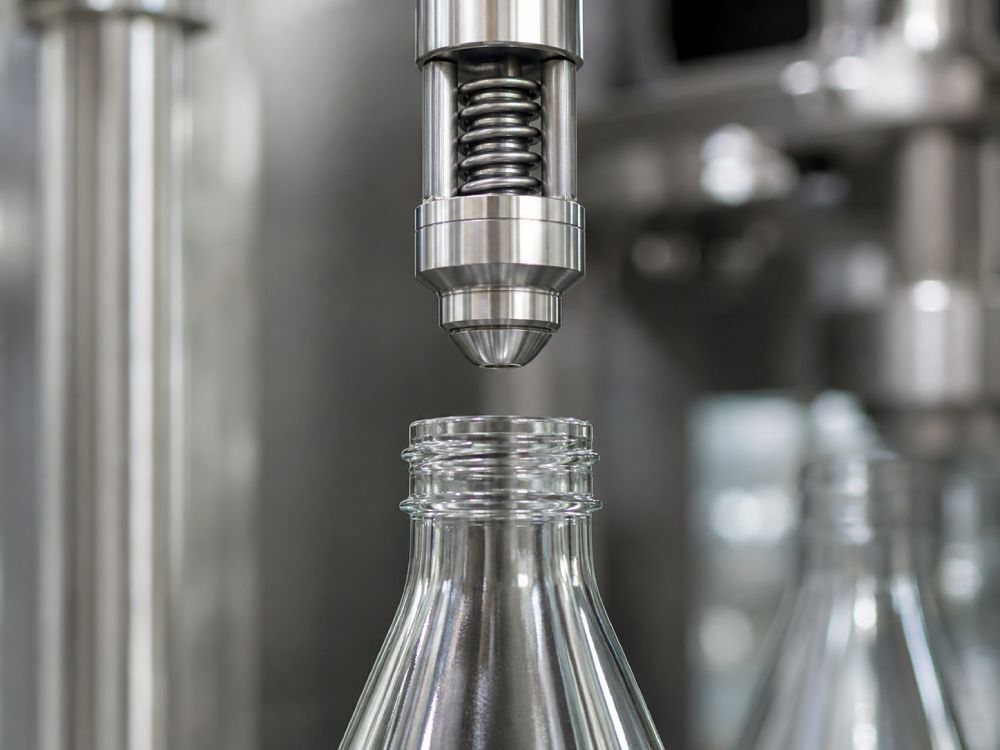
Nozzle performance has a direct impact on both speed and accuracy. At higher fill speeds, the nozzle needs to open and close quickly and cleanly. A nozzle that dribbles or does not cut off sharply will create inconsistent fills and product waste, regardless of how well the rest of the machine is performing.
Anti-drip nozzles, spring-loaded shutoffs, and nozzle designs specific to your product type can make a measurable difference. This is especially true for thin liquids that tend to drip, foamy products that need bottom-up filling, and viscous products that string or tail.
Line Design & Integration Factors That Affect Throughput
Equipment performance is only part of the picture. How the line is designed and integrated has just as much impact on throughput as the machines themselves. A well-matched, properly integrated line will consistently outperform a faster filler dropped into a poorly configured system.
Conveyor Speed & Container Handling
Conveyors set the pace of the entire line. If conveyor speed is not matched to the filler's cycle rate, containers will either back up before the fill head or arrive too quickly for the fill cycle.
Guide rails, timing screws, and star wheels can help ensure containers arrive at the fill head in a consistent, controlled manner. This is especially important at higher speeds, where even small variations in container spacing or orientation can affect fill volume.
For operations running multiple container sizes, adjustable conveyor components reduce changeover time and help maintain consistent container handling across different SKUs.

Accumulation & Line Balancing
Accumulation tables and buffer zones between stations give the line flexibility to absorb minor speed variations without causing backups or stoppages. When one station temporarily slows, accumulated containers keep the downstream stations running rather than forcing the entire line to stop.
Proper line balancing—meaning that every station is matched in speed and capacity to every other station— reduces the stop-and-start cycles that disrupt fill accuracy and wear on equipment. A line that runs at a steady, balanced pace will typically outperform a line with a faster filler that is constantly pausing to wait for downstream equipment.
Upstream Product Supply
The condition of the product entering the filler matters. If the product supply tank is running low, pressure at the fill head drops and fill volumes become inconsistent. If the product temperature fluctuates, viscosity changes, and the fill cycle that was calibrated at one temperature will produce different results at another.
Keeping the supply tank adequately filled, maintaining consistent product temperature, and ensuring proper filtration to prevent particulates from affecting pump or nozzle performance are all factors that support accuracy at higher speeds.
Changeover Efficiency
Changeover time is often overlooked as a throughput factor, but it directly affects the number of production runs that can be completed in a shift. A line that takes 90 minutes to change over between SKUs loses significant productive capacity compared to one that can change over in 30 minutes.
Tool-free adjustments, clearly marked change parts, and standardized procedures all reduce changeover time without compromising the quality of the setup. Faster changeovers also reduce the risk of setup errors that can affect fill accuracy at the start of a new run.
Controls, Automation, & Sensors
Modern filling equipment offers control and monitoring capabilities that were not available on older machines. Taking advantage of these features can help manufacturers run at higher speeds while maintaining fill accuracy and catching problems before they result in rejected containers.
PLC Controls & Programmable Recipes
Programmable logic controllers (PLCs) allow operators to store fill parameters for each product and container combination. When a changeover occurs, the operator selects the saved recipe rather than manually adjusting every parameter from scratch. This reduces setup time and the risk of human error at the start of a new run.
PLCs also allow fine-tuning of fill timing, pump speed, nozzle open and close timing, and conveyor speed—all from a central interface. When a parameter needs to be adjusted, the change is applied consistently across all fill heads rather than requiring individual mechanical adjustments.
Flow Meters & Volume Verification
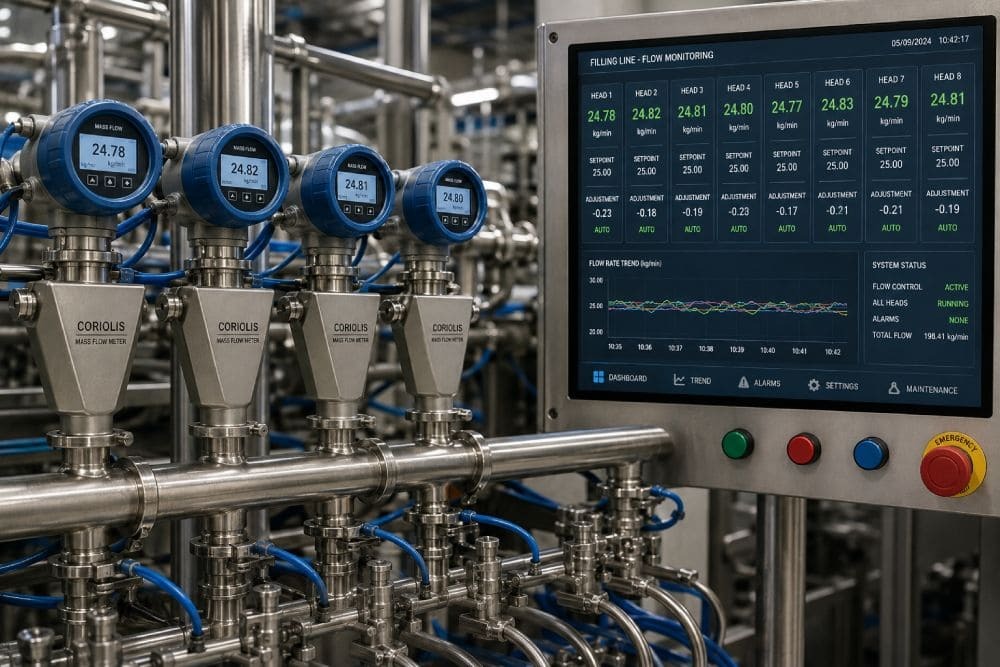
Flow meters provide real-time measurement of the volume being dispensed with each fill cycle. When connected to the machine's control system, they can automatically adjust pump speed or timing to compensate for minor variations in product viscosity, temperature, or supply pressure.
This is particularly valuable at higher speeds, where there is less time to manually identify and correct a fill that is running slightly high or low. Flow meter-based systems can maintain accuracy within tight tolerances even as line conditions change throughout a production run.
Sensors & Reject Systems
Container presence sensors, fill level sensors, and checkweighers can detect underfills, overfills, or missing containers before they reach capping and labeling. Integrating these systems with an automatic reject mechanism removes non-conforming containers from the line without stopping production.
The result is higher effective throughput because the line does not need to slow down to allow operators to manually inspect containers, and non-conforming product is caught before additional packaging costs are added downstream.
Maintenance Practices That Protect Throughput & Accuracy
Equipment that is not properly maintained will not perform consistently at any speed, let alone at higher throughput targets. Wear, buildup, and misalignment are gradual, which means accuracy problems often develop slowly and are not noticed until they have already caused significant product waste or rejected containers.
A preventive maintenance program for your filling machine is one of the most effective ways to protect both throughput and accuracy over time.
What to Monitor Regularly
- Nozzle Condition: Nozzles that are worn, partially clogged, or out of alignment will produce inconsistent fills. Inspect nozzles at regular intervals and replace them before they cause fill problems rather than after.
- Pump Wear: Pump components wear over time, and as they do, the volume delivered per cycle can shift. Regular inspection and scheduled replacement of wear components keeps pump performance within specification.
- Seals and O-rings: Leaking seals can cause pressure loss in the product supply system, which affects fill accuracy. They can also create sanitation issues that require unplanned cleaning downtime.
- Conveyor Belts and Guides: Worn or misaligned conveyor components affect container positioning, which affects fill accuracy. Inspect and adjust regularly, particularly if the line runs multiple shifts.
- Valve and Actuator Response: Valves and actuators that are slow to respond, sticking, or inconsistent will introduce timing errors in the fill cycle. These are often the first components to affect accuracy as a machine ages.
Planned Downtime vs. Unplanned Downtime
Planned maintenance takes the line down on a schedule that can be managed around production demands. Unplanned downtime—caused by a failure that was not caught during routine inspection—is harder to absorb and often more expensive because it happens at the worst possible time.
The goal of a maintenance program is not just to keep the machine running. It is to keep the machine running accurately and predictably, so that throughput gains are not offset by quality problems or unexpected stoppages.
Operator Training & Setup Consistency
Equipment and line design set the ceiling for what is possible. Operators determine how close the line gets to that ceiling on any given shift. Inconsistent setup, incorrect parameter entry, and slow response to developing problems all reduce effective throughput, even when the equipment itself is capable of more.
Setup Consistency
Fill accuracy at the start of a run depends on how consistently the machine is set up. If different operators set the same parameters slightly differently, or if parameters drift between shifts without being corrected, fill volumes will vary from run to run.
Documented setup procedures, clearly marked adjustment points, and PLC-stored recipes reduce the variability that comes from manual setup. When every operator follows the same procedure and the machine stores the correct parameters, the line starts accurately and stays accurate.
Recognizing Early Warning Signs
Operators who understand how the filling machine works are better equipped to recognize when something is beginning to go wrong. A fill that is running slightly high, a nozzle that is starting to drip, or a conveyor that is occasionally misfeeding containers are all early indicators of a developing problem.
Catching these issues early—before they result in a batch of rejected containers or a machine failure—protects both throughput and accuracy. This requires operators who know what normal looks like and are empowered to make adjustments or escalate when they see something that is not right.
Training That Covers the Full Range of Operation
Training for filling line operators should cover more than just how to start and stop the machine. It should include:
- How to perform and verify the setup for each product and container combination
- How to identify and correct common fill accuracy problems
- How to perform basic maintenance checks at the start and end of each shift
- How to execute a changeover correctly and verify accuracy before running production containers
- When to call for technical support rather than attempting a repair that is beyond the operator's scope
A well-trained operator on a well-maintained machine is the most reliable path to consistent throughput and accuracy across shifts.
A Practical Approach: Steps to Increase Throughput Without Losing Accuracy
Improving filling line throughput without sacrificing accuracy is not a single change. It is a process that starts with understanding the current state of the line and works systematically through the factors that are limiting performance. The following steps provide a practical framework for approaching this work.
- Step 1: Document Current Performance – Before making changes, establish a baseline. Measure actual throughput in containers per minute or containers per shift, track fill accuracy across a representative sample of containers, and note where the line is stopping, slowing, or producing non-conforming product. This baseline makes it possible to measure the impact of any improvements.
- Step 2: Identify the Primary Constraint – Use the baseline data to determine where throughput is actually being lost. Is it the filler, a downstream station, changeover time, or unplanned downtime? Confirm the constraint before investing in changes.
- Step 3: Address Equipment Fit before Adding Speed – If the filling technology, nozzle design, or pump type is not well-matched to the product, correcting that mismatch will often improve both accuracy and throughput without any increase in machine speed. This step is frequently overlooked but can produce significant gains.
- Step 4: Optimize Line Integration – Review conveyor speed, container handling, accumulation, and line balancing. Make sure every station is matched in capacity to the others. Add accumulation where needed to smooth out minor speed variations between stations.
- Step 5: Upgrade Controls and Monitoring – If the current machine lacks PLC controls, programmable recipes, or inline verification, these upgrades can support higher speeds by reducing setup variability and catching accuracy problems before they result in rejected containers.
- Step 6: Evaluate Equipment Capacity – If the constraint is genuinely the filler's throughput capacity, consider adding fill heads, upgrading to automatic equipment, or replacing the machine with one that is rated for the target speed. Match the new equipment to the product and container, not just the speed requirement.
- Step 7: Establish Maintenance and Training Programs – Sustainable throughput gains require consistent maintenance and operator performance. Build these programs around the specific equipment on the line and review them regularly as the line evolves.
FAQs About Increasing Filling Line Throughput
What Is the Most Common Reason Filling Line Throughput Is Lower Than Expected?
The most common cause is line imbalance. The filler may be capable of higher output, but a downstream station such as a capper, labeler, or conveyor section cannot keep pace. Identifying and addressing the actual constraint—rather than the assumed one—is the first step toward meaningful throughput improvement.
Can I Increase Throughput Without Buying New Equipment?
In many cases, yes. Optimizing line balance, improving conveyor and container handling, reducing changeover time, upgrading controls, and improving operator setup consistency can all increase effective throughput on existing equipment. New equipment is not always necessary if the current machine has unused capacity and the limiting factors are elsewhere on the line.
How Do I Know If My Filler Is Causing Fill Accuracy Problems?
If fill accuracy is inconsistent and the problem does not correlate with operator changes, product batch changes, or maintenance events, the filler itself may be the source. Check nozzle condition, pump wear, valve response time, and fill timing parameters. If the machine is running at or near its rated speed, it may also be that the speed is simply beyond what the current setup can support accurately.
Does Adding More Fill Heads Always Improve Throughput?
Adding fill heads increases the number of containers filled per cycle, which improves throughput without increasing the cycle rate. However, the downstream stations, including the capper, labeler, and conveyor, must be able to handle the increased output. Adding fill heads to a line where the downstream equipment is already at capacity will not improve overall throughput.
When Does It Make Sense to Replace the Filling Machine Rather Than Upgrade It?
Replacement makes sense when the machine has reached the end of its useful life, when the required throughput significantly exceeds the machine's rated capacity, when the filling technology is no longer a good match for the product, or when the cost of maintaining the existing machine is approaching the cost of new equipment. A qualified equipment manufacturer can help evaluate whether upgrading or replacing is the better investment for a specific situation.
Increase Filling Line Throughput with E-PAK Equipment Built for Your Application
Increasing filling line throughput without sacrificing accuracy comes down to understanding your line, identifying the real constraints, and making targeted improvements to equipment, integration, controls, maintenance, and operator practices. There is no single change that works for every operation. The right approach depends on your product, your containers, your current equipment, and your production goals.
At E-PAK Machinery, we work with manufacturers across a wide range of industries to evaluate filling line performance and identify the right equipment and configuration for their application. Whether you are looking to add fill heads to an existing machine, upgrade from semi-automatic to automatic equipment, improve line integration, or replace aging equipment with a system built for higher throughput, we can help you work through the options and find a solution that fits your production reality.
Are you looking to increase output on your filling line without sacrificing fill accuracy? Contact us today to discuss your application and explore the equipment and configuration options that make sense for your operation.
Recent Posts
- How to Increase Filling Line Throughput Without Sacrificing Accuracy
- What Causes Inconsistent Fill Levels in Liquid Filling Lines?
- How to Vet a Liquid Filling Machine Manufacturer
- Filling Line Integration: How Fillers, Cappers, Conveyors, & Labelers Work Together
- Chuck Cappers vs. Spindle Cappers: Comparison & Selection Guide
