 Loading... Please wait...
Why Labeling Machines Misalign Labels (& How to Fix It)
Posted on 22nd Sep 2026
Label misalignment is one of the most visible problems on a packaging line. A label that sits crooked, rides too high, wraps unevenly, or shifts from container to container is hard to miss, and it creates real downstream consequences. In regulated industries, a shifted label can cover required disclosures or move lot codes out of readable position. On the retail shelf, it signals poor quality before the product is ever opened.
The frustrating part is that misalignment rarely has a single cause. It can come from the machine setup, the container, the label stock, the conveyor, or a combination of all four. That makes it easy to adjust the wrong thing and still have the problem.
This guide covers the most common causes of label misalignment, how to recognize each one, and what to do to fix it.
In this guide:
- Container Handling & Stability Issues
- Label Stock & Web Tension Problems
- Machine Setup & Calibration Errors
- Worn or Damaged Components
- Switching Container Types
- FAQs
Container Handling & Stability Issues
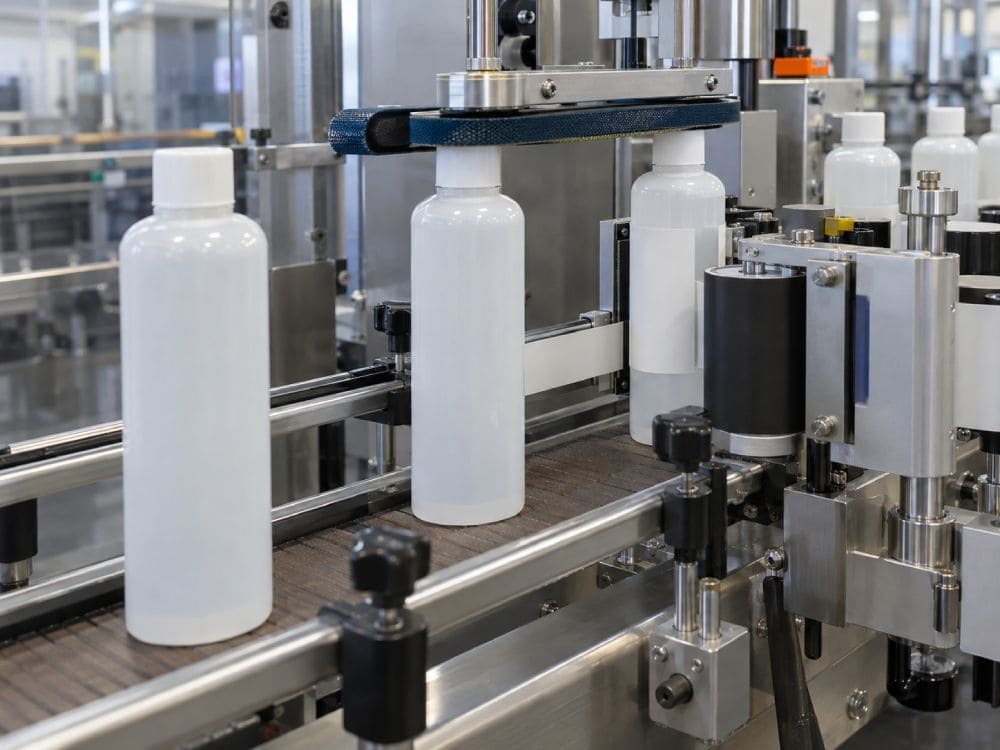
Container handling is the most common source of label misalignment, and it is also the most frequently overlooked. The labeler can be perfectly calibrated, but if the container is not arriving at the applicator in a consistent position, at a consistent speed, and at a consistent height, the label will not go on straight.
What It Looks Like
Labels that shift left or right across a production run, wrap unevenly on cylindrical bottles, or sit at different heights from container to container are usually a container handling problem, not a machine problem.
What Causes It
- Guide rails set incorrectly: Guide rails that are too loose allow containers to drift side to side. Rails set too tight can cause containers to tip or rotate slightly before reaching the applicator. Either condition shifts label placement.
- Conveyor speed not matched to labeler speed: When conveyor speed and labeler application speed are out of sync, containers arrive at the wrong interval, which creates inconsistent label placement.
- Container instability at the applicator: Tall, narrow, or lightweight containers can tip or rotate slightly as the label is applied. Without proper stabilization, the label follows the container's movement rather than the intended position.
- Inconsistent container orientation: For front-and-back or panel labeling applications, containers need to arrive at the applicator in the same rotational position every time. If they do not, panels shift.
How to Fix It
Start with guide rail adjustment. Set rails so the container is held firmly without being squeezed or tilted. Check conveyor speed against the labeler's rated application speed and confirm they are matched. For unstable containers, add a hold-down belt or pressure roller to stabilize the container through the application zone. For orientation-sensitive applications, a timing screw or container registration system ensures consistent rotational position at the applicator.
Label Stock & Web Tension Problems
Label stock and web tension problems are a close second to container handling as a cause of misalignment. The label web feeds from a roll through the machine and across the applicator. Any inconsistency in how that web feeds will show up as inconsistent label placement.
What It Looks Like
Labels that apply at inconsistent intervals, skew diagonally on the container, or shift gradually over the course of a production run often trace back to web tension or label stock issues rather than a machine calibration problem.
What Causes It
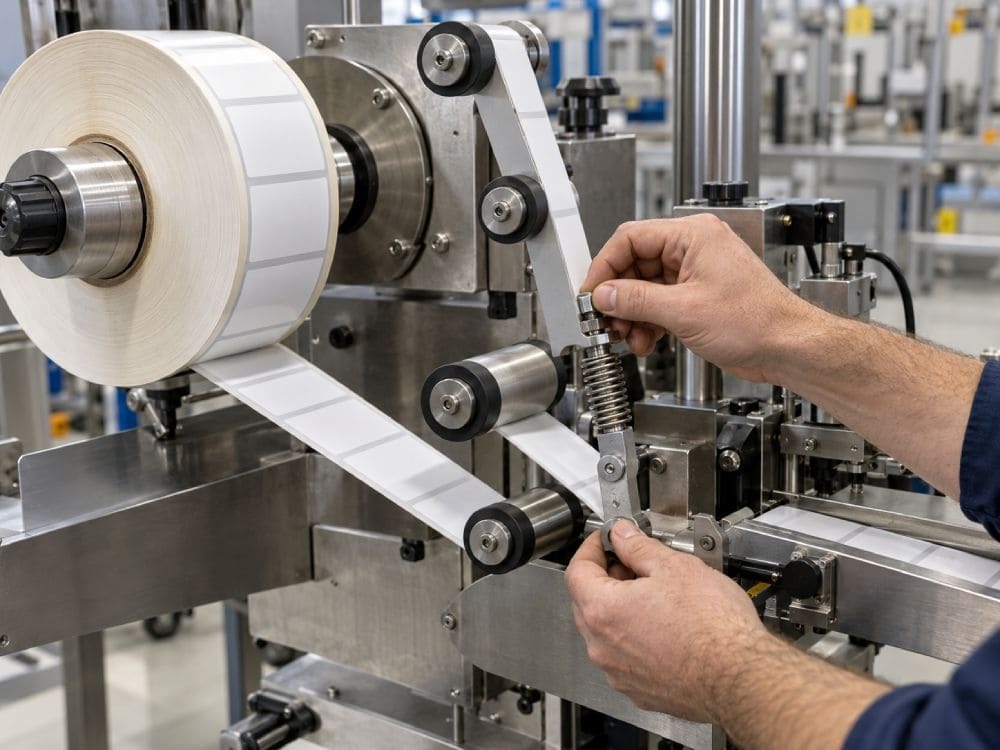
- Inconsistent web tension: Too much tension causes the label to stretch before application, which shifts placement. Too little tension allows the web to wander, producing diagonal or inconsistent placement across containers.
- Label roll loaded unevenly: A roll that is not centered on the unwind mandrel will feed at an angle, causing labels to skew consistently in one direction.
- Label stock variation between rolls: Label stock from different production runs can vary slightly in thickness, stiffness, or liner release force. Switching rolls mid-run without rechecking tension settings can cause placement to drift.
- Liner release issues: If the liner does not release cleanly at the peel plate, the label can hesitate or shift slightly before it contacts the container.
How to Fix It
Check that the label roll is centered and seated correctly on the unwind mandrel before each run. Verify web tension settings and adjust them for the specific label stock in use. If placement drifts after a roll change, recheck tension settings rather than assuming the new roll will behave identically to the last. Inspect the peel plate for wear or buildup that could affect liner release.
Machine Setup & Calibration Errors
Setup errors are responsible for a significant share of label misalignment problems, particularly after a changeover. A machine that was running well on one container size or label format may produce consistent misalignment on the next SKU if the setup was not completed correctly.
What It Looks Like
Misalignment that appears immediately at the start of a new run or that is consistent in direction and magnitude across every container is usually a setup problem. Random or drifting misalignment is more likely a mechanical or web tension issue.
What Causes It
- Applicator height set incorrectly: If the applicator is positioned too high or too low relative to the container, the label will land at the wrong vertical position regardless of how well everything else is adjusted.
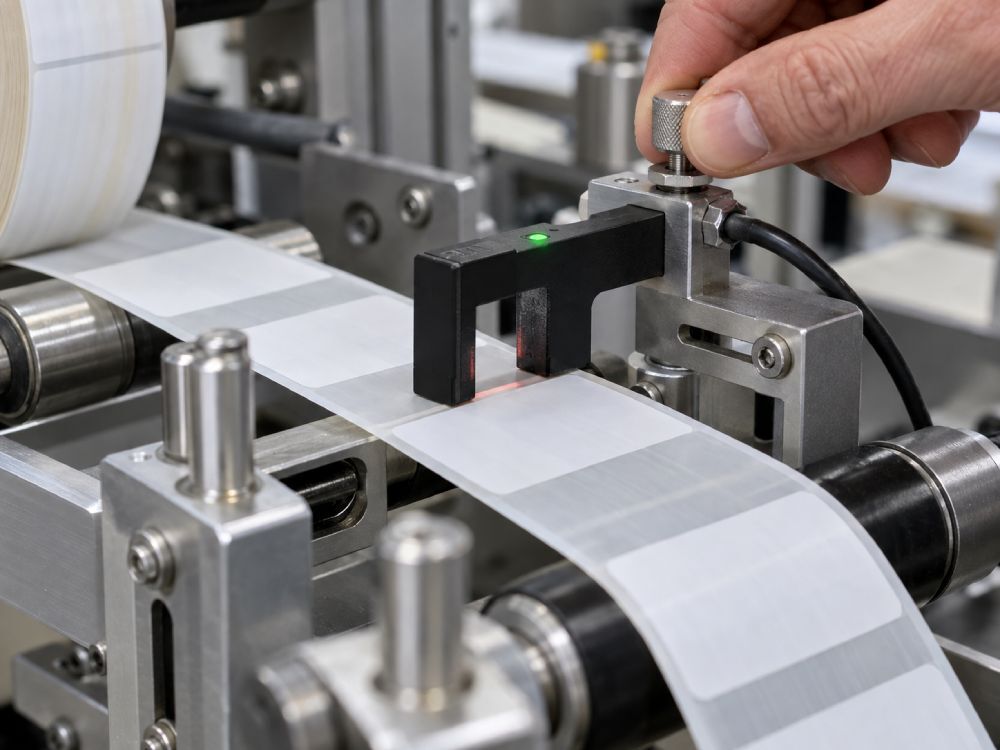
- Label sensor position not updated after changeover: The label sensor detects the gap between labels to trigger the application cycle. If the sensor is not repositioned for a new label size, the trigger point shifts and labels apply early or late.
- Incorrect label offset settings: Most labelers allow operators to fine-tune the application timing through an offset parameter. If this value is carried over from a previous run without adjustment, placement will be off.
- Wrap belt pressure or angle incorrect: For wrap-around labeling, the wrap belt needs to be set to the correct pressure and angle for the container diameter. An incorrect setting causes the label to shift or wrinkle during wrap.
How to Fix It
Document setup parameters for each container and label combination and store them with the machine or in a setup log. When a changeover is completed, verify applicator height, sensor position, and offset settings against the documented values before running production containers. Run a small sample and measure label placement before releasing the full run. Consistent misalignment in the same direction is almost always a setup parameter that needs adjustment, not a mechanical failure.
Worn or Damaged Components
Component wear is a gradual cause of misalignment that develops over time and can be difficult to detect until placement accuracy has already declined significantly. Unlike a setup error, which produces immediate and consistent misalignment, wear-related problems tend to drift slowly and worsen over weeks or months.
What It Looks Like
Placement accuracy that was acceptable six months ago but has gradually declined or misalignment that varies slightly from container to container without a clear pattern is often a sign of component wear rather than a setup or web tension issue.
What Causes It
- Worn drive rollers: Drive rollers that have worn down or developed flat spots no longer feed the web at a consistent speed, which causes label placement to vary across containers.
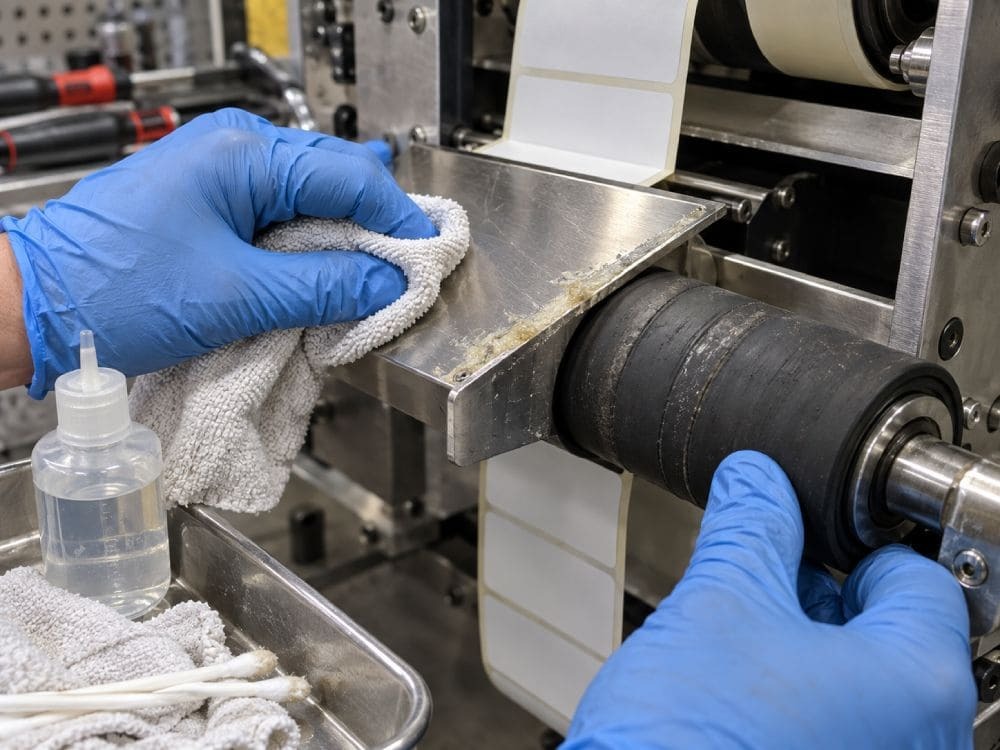
- Worn or damaged peel plate: The peel plate is the edge over which the liner bends to release the label. A worn or nicked peel plate causes inconsistent liner release, which shifts the point at which the label contacts the container.
- Loose or worn bearings: Bearings that have developed play allow machine components to shift slightly during operation, introducing variability that does not trace back to any single setting.
- Worn wrap belt: On wrap-around labelers, a wrap belt that has stretched or worn unevenly will not apply consistent pressure across the full label, causing wrinkles or placement shifts at the trailing edge.
How to Fix It
Include labeler components in a regular preventive maintenance schedule. Inspect drive rollers, the peel plate, and wrap belt at defined intervals and replace them before wear reaches the point where it affects placement accuracy. If misalignment has developed gradually on a machine that was previously performing well, worn components are the most likely cause. Replacement parts will be needed.
Switching Container Types
Switching from one container type to another is one of the highest-risk moments for label misalignment. A machine that was dialed in for one container may produce consistent misalignment on a new one, even when the operator follows the same setup procedure. This is because different container materials, shapes, and surface characteristics change how the label behaves during and after application.
What It Looks Like
Misalignment that begins immediately after a container switch, particularly when the machine was performing well before the change, is almost always a container compatibility issue rather than a machine failure.
What Causes It
- Surface texture differences: Glass and plastic surfaces behave differently under a pressure-sensitive label. Glass tends to be smooth and consistent. Plastic can vary in surface energy depending on the resin and any surface treatments applied during manufacturing.
- Container rigidity: Glass bottles do not flex under wrap belt pressure. Plastic bottles can compress slightly, which changes the effective diameter at the point of label application and shifts wrap placement.
- Container dimensional variation: Plastic containers often have wider dimensional tolerances than glass. A bottle that varies by even a millimeter in diameter from the nominal spec will produce visible label placement variation across a production run.
- Static charge on plastic: Plastic containers can build up static charge, which causes labels to attract or repel in ways that affect placement accuracy, particularly on wrap-around applications.
How to Fix It
When switching container materials, treat it as a full recalibration, not just a changeover. Adjust guide rails, applicator height, and wrap belt pressure for the new container's actual dimensions, not the nominal spec. For plastic containers, test with actual production bottles and measure placement across a sample of at least 20 to 30 containers before releasing the run. If static is contributing to misalignment, a static elimination bar positioned before the applicator can reduce the problem significantly.
FAQs About Label Misalignment
Our Labeling Machine Keeps Misaligning Labels on Round Bottles. Is This a Common Issue, and How Do We Fix It?
Yes, this is one of the most frequently reported labeling problems on liquid packaging lines. Round bottles can rotate slightly as they move through the machine, and even a small amount of rotation shifts label placement. Start by checking guide rail adjustment and conveyor speed synchronization, and add a hold-down belt or pressure roller if the bottle is rotating at the applicator. For bottles with seams or embossing, a container registration system that orients each bottle consistently before labeling is often the most reliable fix.
I'm Switching from Glass to Plastic Bottles and My Labeler Keeps Misaligning. What Adjustments Should I Make, or Should I Upgrade?
Switching from glass to plastic almost always requires a full recalibration, not just a changeover. Plastic bottles have wider dimensional tolerances, a different surface energy, and flex under wrap belt pressure in ways glass does not. Adjust guide rails, applicator height, and wrap belt pressure for the actual dimensions of the plastic container, then verify with a sample run before releasing production. If the machine is not adjustable enough to accommodate the new container, E-PAK's labeling machines are built to handle a range of container materials and surface conditions.
We Switched to a New Labeling System Last Month but Accuracy Keeps Dropping. What Could Be Causing This?
A system that starts well and then degrades is a different problem than one that never performed. The most likely causes are web tension drift as the label roll depletes, label stock variation between rolls, or a component showing early wear. Check web tension settings, inspect the peel plate and drive rollers for wear or buildup, and verify that operator setup is being executed consistently. A new system should not require repeated recalibration to maintain basic placement accuracy.
Get Consistent Label Placement with the Right Equipment and Support from E-PAK
Label misalignment is a solvable problem in most cases. The cause is almost always one of four things: container handling that is not consistent enough, web tension or label stock that is not properly set, a setup parameter that needs adjustment, or a component that has worn past the point where it can maintain placement accuracy. Working through those causes in order is faster than adjusting settings at random.
When the problem is not the machine but the container, the fix may be upstream. When the problem is the machine's ability to handle a new container type, the fix may be a different configuration or a new system.
At E-PAK Machinery, we build and support labeling equipment for a wide range of container types, label formats, and production environments. Whether you are troubleshooting a placement problem on an existing line, evaluating whether your current machine can handle a new container, or building a new labeling system from the ground up, we can help you work through the options.
Are you dealing with label misalignment on your packaging line? Contact E-PAK Machinery to discuss your application and get the right support for your equipment and production goals.
Recent Posts
- Why Labeling Machines Misalign Labels (& How to Fix It)
- Labeling Machine Guide: Choosing the Right System for Your Product
- How to Increase Filling Line Throughput Without Sacrificing Accuracy
- What Causes Inconsistent Fill Levels in Liquid Filling Lines?
- How to Vet a Liquid Filling Machine Manufacturer
